Seating, Lighting, Noise: How Your Classroom Environment Is Affecting Attention (Without You Realizing It)
Seating, Lighting, Noise: How Your Classroom Environment Is Affecting Attention (Without You Realizing It)
By Lauren Bochicchio Beaver
Teachers spend enormous energy on lesson planning, differentiation, and student relationships. But there's a layer of the classroom that affects attention before a single word is spoken, before a lesson begins, before a child has made any choice at all.
The environment itself.
The room students sit in sends constant signals to the brain — signals about safety, stimulation, and how much cognitive work it will take just to be present. For students who already find sustained focus effortful, a poorly designed environment doesn't just make learning harder. It can make it nearly impossible.
The good news: most of the highest-impact changes cost nothing. They just require knowing where to look.
Seating: It's Not About Behavior, It's About Brain Load
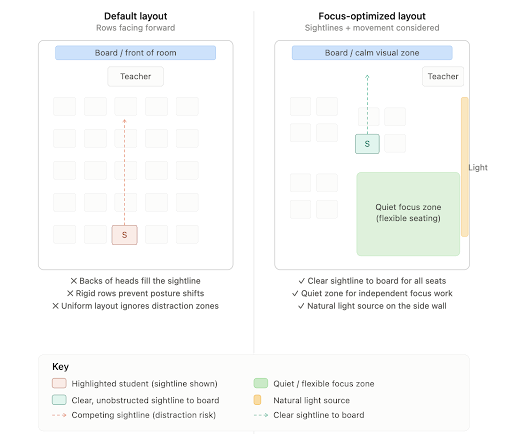
The default classroom seating arrangement — rows facing forward, or clusters of four — was designed for crowd management, not cognitive performance. Neither automatically serves attention well.
Rows can work for independent, focused work, but they create a visual field full of the backs of other students' heads, backpacks, and movement — all of which compete for attention without the student choosing to look. Clusters are great for discussion and collaboration, but for a student trying to sustain individual focus, they place three other faces directly in their sightline.
A few things worth reconsidering:
Sightlines matter more than proximity. A student seated near the front isn't necessarily better positioned for attention than one seated further back — what matters is whether their natural forward gaze lands on something calm and uncluttered, or on a busy display board, a doorway, or other students.
Movement isn't the enemy of focus. Research consistently shows that the ability to make small postural adjustments — shifting weight, changing position slightly — actually supports sustained attention rather than undermining it. Rigid seating that prevents any movement forces the brain to spend energy on physical discomfort instead of the task at hand. Wobble stools, standing options, or simply giving students permission to sit how they need to can make a meaningful difference.
Predictability reduces cognitive load. Students who know where they sit, what's expected in that space, and what the physical routine looks like arrive at that seat with one less thing to figure out. That matters more than it sounds.
Lighting: The Most Overlooked Variable in the Room
Fluorescent overhead lighting is a fixture of almost every classroom in the country. It's also one of the most attention-hostile environments the brain can sit under for six hours a day.
Harsh, uniform fluorescent light — particularly older fixtures that flicker at imperceptible frequencies — triggers subtle stress responses in the nervous system. It flattens the visual environment, making it harder for the brain to distinguish what to focus on. It can cause headaches, eye strain, and fatigue that students often can't name but absolutely feel.
Natural light is the single most powerful upgrade available, and it costs nothing. Studies have consistently linked access to natural light in classrooms with improved attention, better mood, and stronger academic performance. If your room has windows, use them. Orient student seating toward natural light sources where possible, and resist the habit of pulling blinds to reduce screen glare — the tradeoff rarely favors the students.
Where natural light is limited, warmer, lower-intensity supplemental lighting — even a single lamp in a reading corner — can meaningfully change how a space feels to a nervous system trying to settle and focus.
One practical check: turn off the overhead lights for a single afternoon and see what happens to the room's energy. The response is often immediate and striking.
Noise: The Invisible Competitor for Attention
Sustained attention requires the brain to filter — to hold relevant information at the front and push irrelevant information to the back. Noise makes that filtering work harder.
Not all noise is equal. Background noise at a consistent, low level — the hum of an HVAC system, distant hallway sounds — is far less disruptive to attention than unpredictable, variable noise. It's the sudden chair scrape, the hallway door slamming, the sporadic conversation from the next room that forces the brain to re-orient, re-filter, and re-engage with the task. For students who find that re-engagement difficult, each interruption is a significant setback — not a minor annoyance.
A few practical considerations:
Establish acoustic anchors. If your room tends toward noise variability, consistent low-level background sound — soft instrumental music, a white noise source — can actually improve focus by reducing the contrast of unexpected sounds. The brain habituates to consistent background noise more easily than it copes with unpredictability.
Think about your own voice. Volume and pace of teacher speech directly affect student attention. A voice that stays at one steady volume throughout a lesson blends into the background. Deliberate variation — quieter when you want focus, a pause before a key point — trains student attention far more effectively than repeating instructions louder.
Name the noise norms explicitly. Many students don't know what level of noise is expected during different types of work — and the ambiguity itself is a cognitive distraction. "This is a silent work block" and "quiet partner conversation is fine right now" are instructions that reduce the mental overhead of figuring out the room's rules.
Visual Clutter: The Wall You Stopped Seeing
Walk into most classrooms and look at the walls. Really look.
Anchor charts from three units ago. Motivational posters competing with learning targets competing with student work competing with calendar displays. Bright colors in every direction. A visual field so full that the brain can't find anywhere to rest.
Classroom walls accumulate over the course of a school year, and because the change is gradual, teachers often stop seeing what students are sitting inside every day. But the brain never stops processing it. Visual complexity in the peripheral field is a constant, low-level draw on attention — a background hum of stimulation that raises the baseline cognitive load before instruction even begins.
This doesn't mean bare walls. Student work, community-building displays, and reference materials all have a place. But intentionality matters. A wall with five well-chosen, well-spaced things on it is more supportive of focus than a wall covered in thirty. Rotating displays rather than layering them keeps the environment fresh without overwhelming it.
The area directly in students' forward sightline during instructional time deserves particular attention. That zone should be as uncluttered as you can make it.
The Bigger Picture
None of these changes require a budget, an administrator's approval, or a full classroom redesign. They require noticing — sitting in your students' seats, looking at what they see, listening to what they hear, feeling what their nervous systems feel over the course of a school day.
The environment is always teaching. The question is whether it's teaching focus or undermining it.
For students who are actively working to build stronger attention — whether through structured practice, support from a clinician, or tools like Skylar's Run — a well-designed environment isn't a nice-to-have. It's the difference between training on a clear track and training in sand. The effort is the same. The outcomes aren't.
Thynk is a cognitive health technology company dedicated to improving focus and attention in students through validated, brainwave-powered training. Learn what's possible → https://thynk.com/book-a-demo